

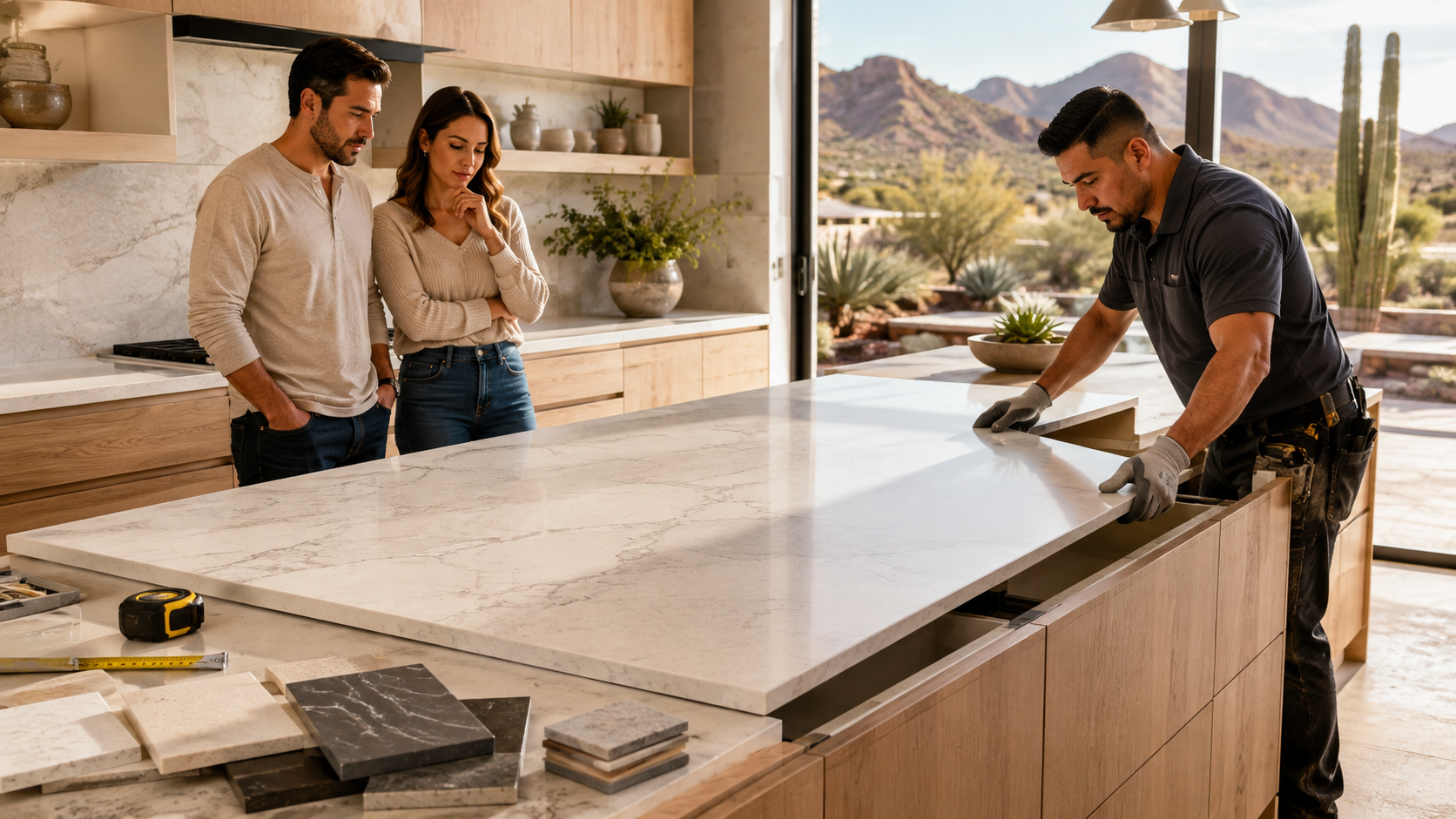
Replacing countertops can completely change the way a kitchen or bathroom looks and functions, but cost is usually one of the first questions homeowners ask. The challenge is that there is no single price that fits every project. A compact bathroom vanity, a straightforward galley kitchen, and a large kitchen with an oversized island can all require very different budgets.
For Tempe homeowners, the best way to plan is to understand what actually goes into a countertop quote. Material is only one part of the total. Square footage, fabrication, edge profiles, sink and cooktop cutouts, removal of existing counters, plumbing work, cabinet condition, and installation complexity can all affect the final number.
National 2026 cost data provides a useful starting point. Angi reports that countertop installation typically costs about $1,852 to $4,464, while projects can fall outside that range depending on size and material. These figures are useful for initial planning, but a Tempe-specific estimate should be based on your measurements, selected material, layout, and site conditions.
Homeowners comparing options can also turn to Manufacturers Floor Covering Outlet in Tempe for product guidance and project planning. Understanding the cost drivers before selecting a surface can help you spend where it matters most and avoid surprises later.
What Does Countertop Installation Cost in 2026?
A countertop budget usually has two major pieces: the material itself and the work required to fabricate and install it. Depending on the product, those costs may be quoted together or separated.
Angi's 2026 national data puts a typical countertop installation project between $1,852 and $4,464. This Old House gives a similar broad total range of $1,863 to $4,392 and notes that material, kitchen size, and labor are major cost factors.
Those numbers are useful benchmarks, not fixed Tempe prices. A simple replacement using a value-focused material may come in below the national average, while a large custom layout using a premium slab, specialty edges, multiple cutouts, or additional trade work may cost considerably more.
Why Per-Square-Foot Prices Can Be Misleading
Countertop materials are often discussed by the square foot, but a per-square-foot figure rarely tells the entire story. Two kitchens with the same countertop area can have different costs if one has a basic rectangular layout and the other includes an island, several corners, a waterfall edge, a cooktop cutout, and a farmhouse sink.
Published price ranges also differ depending on whether the source is describing material only or installed cost. That's why homeowners are better served by comparing complete written estimates rather than focusing on a single advertised square-foot number.
Think in Terms of the Whole Project
A realistic budget accounts for the complete process:
Countertop material
Measuring or templating
Fabrication
Edge finishing
Sink, faucet, and cooktop cutouts
Delivery
Installation labor
Existing countertop removal when needed
Debris disposal
Plumbing or electrical reconnection when required
Cabinet adjustment or reinforcement if necessary
Knowing which of these items are included in a quote makes it much easier to compare proposals fairly.
1. Countertop Material Is Usually the Biggest Cost Driver
The surface you choose has a major influence on the project total. Laminate, tile, solid surface, granite, quartz, marble, and other materials have different material prices as well as different fabrication and installation requirements.
This Old House's 2026 countertop guide lists broad installed cost ranges of about $10 to $40 per square foot for laminate, $35 to $100 for granite, $50 to $200 for quartz, $20 to $50 for solid surface, and $12 to $45 for tile. These national figures are best treated as comparison ranges rather than local quotes.
Laminate
Laminate can be attractive for homeowners who want broad color and pattern choices while keeping the budget controlled. The shape of the countertop, edge treatment, backsplash details, and whether the project uses stock or custom fabrication can still affect the final price.
A simple layout will generally be easier to budget than a heavily customized one.
Solid Surface
Solid surface materials are valued for their streamlined appearance and design versatility. Depending on the product, they can allow integrated-looking details and inconspicuous seams.
Costs vary by brand, color, finish, edge treatment, and fabrication requirements. HomeAdvisor's June 2026 solid-surface guide reports a national installed project average of $3,763 and says project totals commonly range from $2,065 to $5,695. That wider project-level range is another reminder that real costs depend on much more than material alone.
Granite and Quartz
Granite and quartz remain popular choices for homeowners who want a substantial slab countertop. Their pricing can change considerably based on color, pattern, grade, slab availability, thickness, fabrication, and the complexity of the layout.
HomeAdvisor reports an average 2026 quartz project cost of about $4,500, with a broad range of $1,500 to $8,000. Granite projects average around $3,250 in its current cost data, with common project totals around $2,000 to $4,000.
These are national averages. They are useful for understanding relative budget levels, but not for predicting an exact Tempe installation.
2. Countertop Size and Kitchen Layout Matter
Square footage seems straightforward: more countertop means more material. In practice, layout matters almost as much as total area.
A long, straight run of cabinets may be relatively efficient to fabricate. A kitchen with an island, peninsula, multiple corners, angled walls, or separate countertop sections can involve additional measurements, seams, cuts, and labor.
Measure for Planning, Not Ordering
Homeowners can take rough measurements for an early budget, but final fabrication measurements should come from the countertop provider or installer. Small differences matter when a surface must fit between walls, appliances, and cabinets.
Islands Can Add More Than Square Footage
A large island often becomes the visual center of a kitchen, so homeowners may choose a thicker-looking edge, wider overhang, specialty shape, or statement slab. Each of those choices can influence fabrication and material usage.
If keeping costs under control is the priority, ask which island dimensions and edge details make the most efficient use of the selected material.
3. Edge Profiles, Cutouts, and Custom Details Add Fabrication
Countertops rarely arrive as untouched slabs. They need to be fabricated to fit the room and the fixtures that will be installed with them.
Edge Profiles
A simple edge can be more straightforward to fabricate than an elaborate decorative profile. The exact cost difference depends on the material and fabricator.
If you like a premium edge, consider using it where it will be most visible rather than assuming every section needs the same treatment.
Sink and Cooktop Cutouts
Undermount sinks, cooktops, faucets, soap dispensers, and other fixtures may require precise openings. Some quotes include standard cutouts while others price them separately.
Ask how many cutouts are included and whether specialty sink shapes or appliance configurations create additional charges.
Backsplashes and Waterfall Edges
A countertop backsplash uses more material and fabrication than the horizontal counter alone. Waterfall edges, where countertop material continues vertically down the side of an island or cabinet, can also increase material use and require careful pattern alignment.
These details can look beautiful, but they are worth pricing before finalizing the design.
When you're comparing materials, colors, and design details for kitchen countertops, look at the complete installed design rather than choosing a surface based only on the sample price.
4. Removing Existing Countertops Can Affect the Budget
A replacement project often begins with demolition. Existing countertops may need to be disconnected, removed, carried out, and disposed of before the new installation can begin.
Angi specifically advises homeowners to account for old-counter removal, debris disposal, and plumbing or electrical reconnections when planning a countertop budget.
Removal Difficulty Varies
A lightly attached laminate top can be very different to remove from a heavy stone slab or a tiled surface built over a substantial substrate. Access also matters. Tight hallways, stairs, large islands, and limited working space can change the amount of labor involved.
Before accepting a quote, confirm whether removal and disposal of the old countertop are included.
Protecting Cabinets Is Important
If the existing cabinets are staying, demolition needs to be handled carefully. Damage to cabinet boxes or support structures can turn a countertop replacement into a larger renovation.
This is one reason a professional assessment before installation can be valuable. It helps identify whether the existing base is ready for the new surface.
5. Plumbing, Electrical, and Appliance Work May Be Separate
New countertops often interact with sinks, faucets, garbage disposals, cooktops, outlets, and other fixtures. The countertop installer may not be the person who disconnects or reconnects every component.
HomeAdvisor's current quartz cost guidance specifically notes that homeowners may need to budget for old-counter removal, cabinet leveling, and plumber fees in addition to the countertop itself.
Sink Work
If a sink is being reused, it may need to be disconnected before removal and reconnected after the new top is installed. If you're replacing the sink, the plumbing configuration may also need adjustment.
Changing from a drop-in sink to an undermount sink can affect both fabrication and installation planning.
Cooktops and Electrical Items
A cooktop cutout needs to match the appliance specifications. Depending on the project, electrical or gas work may need to be coordinated separately with the appropriate professional.
Ask early who is responsible for each part of the project. Clear responsibilities make scheduling smoother and help prevent forgotten costs.
6. Cabinet Condition Can Change the Scope
Before installation, base cabinets need to be stable, appropriately supported, and sufficiently level for the selected material.
Existing Cabinets May Need Adjustment
Older cabinets can settle over time. Remodels may also reveal uneven runs, damaged cabinet boxes, or previous modifications that were hidden by the old countertop.
Minor adjustment may be straightforward. Larger repairs or reinforcement can add cost and time.
Don't Finalize the Countertop in Isolation
If cabinets are also being replaced, coordinate the two parts of the project. Countertops are typically measured after base cabinets are installed and secured because fabrication depends on the final cabinet layout.
For a broader kitchen remodel, sequencing matters just as much as product choice.
7. Project Complexity Influences Labor and Scheduling
A straightforward installation and a highly customized installation require different amounts of time and skill.
Features that may increase complexity include:
Multiple seams
Unusual wall angles
Large or heavy slabs
Long overhangs
Waterfall panels
Detailed edge profiles
Multiple sink or appliance cutouts
Tight access to the kitchen
Cabinet repairs or leveling
Coordinating several trades
Complexity does not mean a feature is a bad choice. It simply means it belongs in the budget from the beginning.
How Tempe Homeowners Can Build a More Realistic Countertop Budget
The most useful budget includes a little flexibility instead of spending every dollar on the material itself.
Start With Your Priorities
Decide what matters most before shopping.
Is your priority:
A particular look?
Easy everyday care?
A specific material?
Staying within a firm overall budget?
Creating a statement island?
Updating the room for long-term use?
Coordinating with new flooring or cabinets?
Once you know what you value most, it becomes easier to make trade-offs elsewhere.
Compare Complete Quotes
A lower initial number is not necessarily the lower final cost if major items are excluded.
When reviewing a proposal, look for clarity around:
Material and quantity
Fabrication
Edge profile
Number of cutouts
Delivery
Installation
Removal and disposal
Plumbing responsibilities
Cabinet preparation
Backsplash work
Any other separately priced upgrades
If two quotes define the project differently, comparing only the totals can be misleading.
Keep a Contingency
Renovations sometimes uncover conditions that were not visible during early planning. A cabinet may need adjustment, plumbing may need to move, or a homeowner may decide to upgrade the sink once the old countertop is removed.
Keeping part of the budget uncommitted gives you more room to make good decisions without disrupting the entire project.
Where Can You Save Without Sacrificing the Finished Look?
Controlling cost does not mean choosing the least expensive option in every category. Often, the better strategy is to simplify details that matter less so you can spend more on the features you notice every day.
Choose a Simpler Edge
A clean, straightforward edge can work beautifully in modern and transitional kitchens. If an elaborate profile does not substantially change the design for you, simplifying it may reduce fabrication costs.
Work With Efficient Dimensions
If you're building a new island or replacing cabinets, ask whether small dimension adjustments could make better use of standard material sizes or slab layouts.
Limit Specialty Features
A waterfall edge or full-height countertop backsplash can become a focal point, but using these details selectively may provide the visual impact you want without applying them everywhere.
Select Material With the Whole Room in Mind
The most premium slab is not automatically the material that looks best in your kitchen. Cabinet color, flooring, lighting, backsplash, and wall finishes all influence the final result.
A well-coordinated midrange surface can look more intentional than an expensive countertop chosen without considering the rest of the space.
Why a Detailed Estimate Matters More Than an Online Cost Calculator
Online cost guides are useful for early expectations, but they cannot see your kitchen.
An accurate estimate needs to account for your actual dimensions, material choice, sink and appliance configuration, edge details, existing countertops, cabinet condition, access, and installation requirements.
That distinction is especially important with the wide national cost ranges seen in 2026. Angi's current data shows a typical installation range of roughly $1,852 to $4,464, while material-specific projects such as quartz can extend well beyond that range depending on size and selections.
Use online figures to plan. Use a project-specific estimate to make the final decision.
Plan Your Tempe Countertop Project With Confidence
Countertop installation costs make more sense once you break the project into its individual parts. Material is important, but so are square footage, layout, fabrication, cutouts, removal, plumbing, cabinet preparation, delivery, and professional installation.
For Tempe homeowners, the smartest budgeting approach is to start with a realistic overall range, decide which design features matter most, and then request an estimate based on the actual room. That gives you a clearer picture than relying on a single square-foot figure.
Manufacturers Floor Covering Outlet serves Tempe as well as Scottsdale, Gilbert, Chandler, and Mesa, helping homeowners explore materials and plan updates that balance style, function, and value. Whether you're refreshing one countertop or coordinating a larger kitchen project, knowledgeable guidance can help you understand the choices behind the final price.
If you're ready to discuss countertop options and get a more project-specific idea of what your Tempe remodel may involve, get in touch with the Manufacturers Floor Covering Outlet team.


